


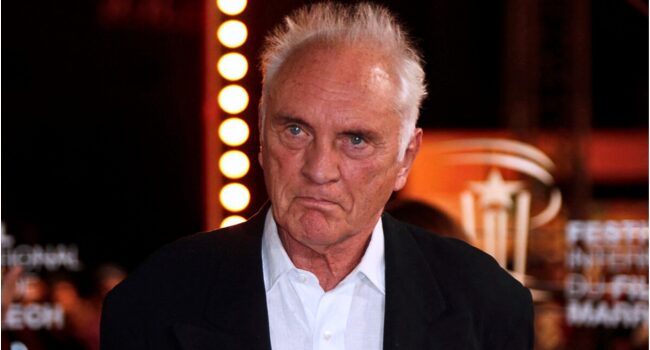
British actor Terence Stamp, one of the most striking screen presences of the 1960s who later reinvented himself in unforgettable roles, has passed away at the age of 87. His family confirmed the news, saying he leaves behind “an extraordinary body of work, both as an actor and a writer, that will continue to inspire for years to come.”
Stamp’s career began with a bang in the early ’60s. He was introduced to the world in Billy Budd (1962), Peter Ustinov’s adaptation of Herman Melville’s novel. His moving performance as a young sailor condemned to death earned him an Academy Award nomination and a Golden Globe, immediately establishing him as a star.
Through the decade, he became known for playing troubled and magnetic characters. His turn in The Collector (1965), a dark love story, won him Best Actor at Cannes. Directors like Federico Fellini and Pier Paolo Pasolini saw in him a rare mix of beauty, danger, and vulnerability. Fellini cast him in Spirits of the Dead as a doomed, self-destructive actor, while Pasolini gave him a legendary role in Theorem, where he played a mysterious visitor who upended an entire Milanese household.
But it was not all arthouse cinema. Stamp eventually embraced popular culture with the same intensity. In the 1980s, he found worldwide recognition as General Zod in Superman II, hurling the immortal line “Kneel before Zod!”—a phrase still echoing today in tributes across social media.
Far from being confined to villainy, Stamp delighted audiences with his versatility. In The Adventures of Priscilla, Queen of the Desert (1994), he delivered a tender and bold performance as Bernadette, a transgender woman whose poise and wit captivated viewers and critics alike. He also appeared in major blockbusters like Star Wars: The Phantom Menace while continuing to take risks in independent cinema, with roles in films like Stephen Frears’s The Hit.
Over his six-decade career, Stamp appeared in more than 60 films, leaving an indelible mark on both European art cinema and Hollywood spectacle. Born in London in 1938, from modest beginnings, he rose to become one of the defining actors of his generation—an artist who could shift effortlessly between tortured soul, commanding villain, and unexpected hero.
His life off-screen was as much part of his legend, from his celebrated romance with supermodel Jean Shrimpton to his reflections on the price of being a cultural icon of the 1960s. “I was so closely identified with that era,” he once said, “that when it ended, I felt finished with it.” Yet, in truth, he never was.
Terence Stamp’s legacy is that of a performer who continually reinvented himself—brooding, daring, unforgettable.