


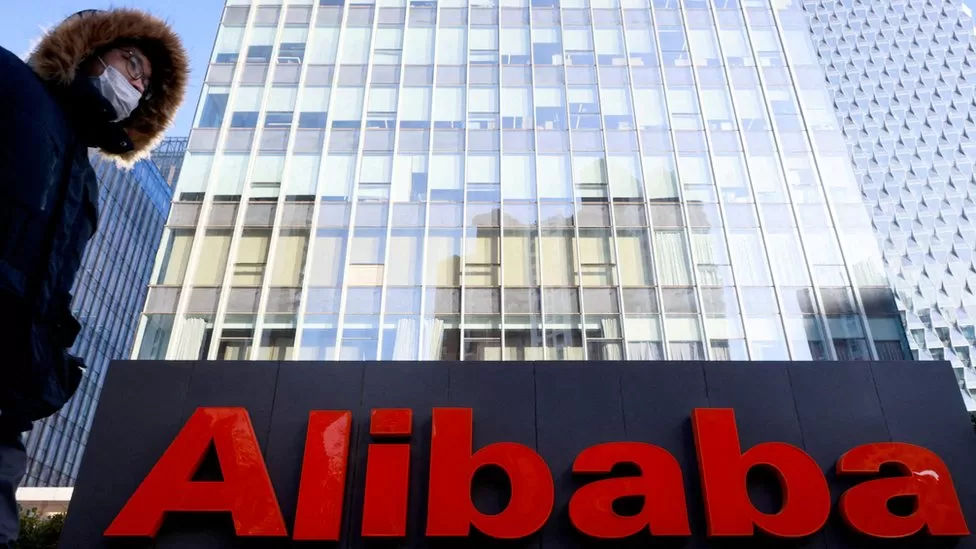
Alibaba, the Chinese technology giant, has announced plans to launch its own ChatGPT-style artificial intelligence (AI) product called Tongyi Qianwen.
Its cloud computing unit says it will integrate the chatbot across all of Alibaba’s businesses in the “near future,” but no timetable was provided.
In recent months, technology companies all over the world have debuted their own “generative AI chatbots.”
Alibaba revealed earlier this year that it was developing a competitor to ChatGPT.
Tongyi Qianwen translates roughly as “seeking an answer by asking a thousand questions,” though Alibaba has not provided an English translation.


“We are at a technological tipping point driven by generative AI and cloud computing,” Alibaba’s chairman and CEO Daniel Zhang said at the launch of Tongyi Qianwen.
Tongyi Qianwen, which can work in both English and Chinese, will initially be added to DingTalk, Alibaba’s workplace messaging app.
According to the company, it will perform a variety of tasks such as converting meetings into written notes, writing emails, and drafting business proposals.
Alibaba said it will also be integrated into Tmall Genie, a smart speaker similar to Amazon’s Alexa voice assistant.
Since the release of ChatGPT by Microsoft-backed OpenAI in November, there has been a surge in interest in generative AI.
Generative AI can learn from past data to create content that is indistinguishable from human work.
ChatGPT can respond to questions in natural, human-like language and can mimic other writing styles, using the internet as it existed in 2021 as its database.
Microsoft has spent billions of dollars on the technology, which was introduced in February to its search engine Bing.

The US software giant also stated that it will include a ChatGPT version in its Office apps, which include Word, Excel, PowerPoint, and Outlook.
Alphabet’s Google and China’s Baidu have both announced their own AI models and launched similar chatbots.
China’s cyberspace regulator unveiled draft measures for managing generative AI on Tuesday.
According to the Cyberspace Administration of China, companies would be responsible for the legitimacy of data used to train the technology under the proposed rules.
The public has until May 10 to comment on the proposals.
Last month, a group of high-profile figures in the technology industry called for the suspension of powerful AI system training due to concerns about a threat to humanity.
Elon Musk, CEO of Twitter, and Steve Wozniak, co-founder of Apple, were among those who signed an open letter warning of potential risks and claiming that the race to develop AI systems is out of control.
Meanwhile, according to a recent report by investment bank Goldman Sachs, AI could replace the equivalent of 300 million full-time jobs.
Italy became the first Western country to block ChatGPT earlier this month, citing privacy concerns to the country’s data protection authority.