


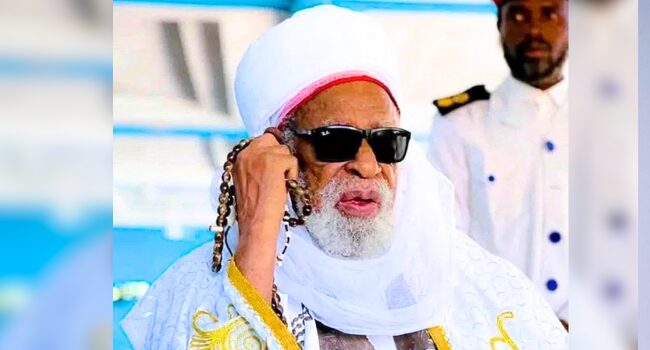
Renowned Islamic scholar and leader of the Tijjaniyya order, Sheikh Dahiru Usman Bauchi, has passed away at the age of 102.
The cleric died early Thursday, leaving behind a legacy of faith, knowledge, and service. Bauchi State Governor Bala Mohammed described the loss as one of national significance, praising Sheikh Dahiru’s lifelong dedication to peace, tolerance, and interfaith harmony.
In a statement shared by his media adviser, Mukhtar Gidado, Governor Mohammed extended heartfelt condolences to the Sheikh’s family, students, followers, and the broader Muslim community.
“Sheikh Dahiru Usman Bauchi was a towering figure in Islamic scholarship,” the governor said. “He embodied faith, humility, and wisdom throughout his remarkable life.”
Sheikh Dahiru devoted his life to teaching the Qur’an, promoting Islamic knowledge, and uplifting communities spiritually and morally. His schools and learning centers produced thousands of Qur’an memorisers who have gone on to share Islamic teachings across Africa.
The governor highlighted that the Sheikh’s contributions to theology, jurisprudence, and Islamic history left an enduring mark on society. He also promised continued support for the institutions and values the cleric championed, especially in Islamic education and community development.
Born on June 29, 1927, in East Gombe, Sheikh Usman hailed from a family with roots in both Bauchi and Gombe. He held a Tijjaniyya ijāzah recognised throughout West Africa and served as deputy chair of the Fatwa Committee of the Supreme Council for Islamic Affairs.
Notably, he was briefly detained in Saudi Arabia in 2009 during the pilgrimage due to doctrinal tensions involving Nigerian Islamic groups. Sheikh Dahiru married a daughter of the prominent Tijani scholar Sheikh Ibrahim Niasse, in a ceremony conducted in Kaolack, Senegal.
Katsina State Governor Dikko Radda also mourned the cleric, describing him as a pillar of moral authority.
“Throughout his life, Sheikh Dahiru remained a voice of reason, a moral compass, and a symbol of spiritual enlightenment,” Radda said. “His departure leaves a void that will be deeply felt across generations. He was more than a religious leader — he was a guide, a father, and a unifying force whose wisdom and humility inspired millions across Nigeria and beyond.”
