


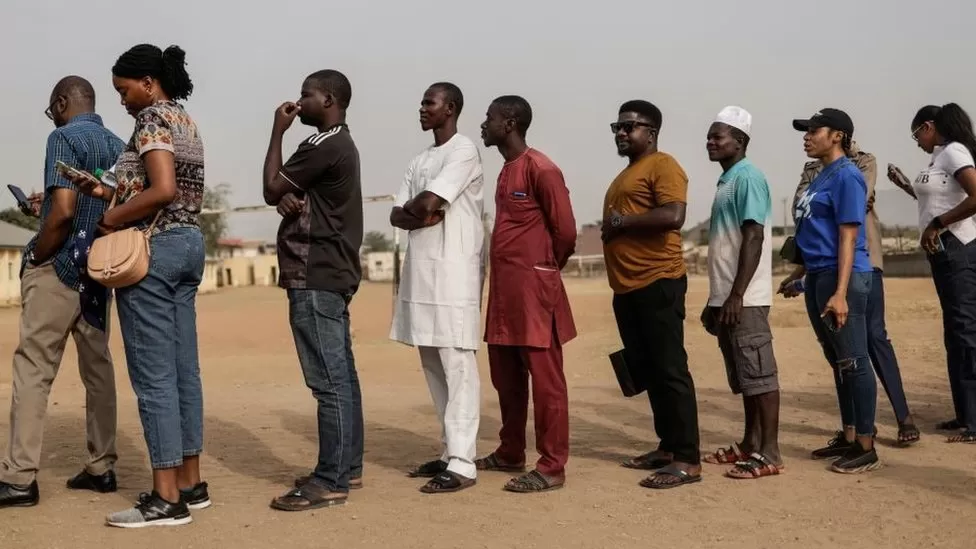
Voting in Nigeria’s most competitive presidential election since military control ended has officially concluded, but lengthy lines continue at polling places as millions wait to vote.
Voting delays are being blamed on security concerns and logistical issues.
Criminal gangs have stormed polling booths and carted away voting devices.
With 87 million people eligible to vote, the elections are Africa’s largest democratic exercise.
Since the end of military rule in 1999, two parties have dominated politics: the ruling APC and the PDP.
But, there is a significant challenge from a third-party candidate in the campaign to succeed President Muhammadu Buhari this time – the Labour Party’s Peter Obi, who has the support of many young people.
Several voters complained to the BBC that their polling places did not open two hours before they were supposed to close.
Voting equipment failed in various regions, forcing voters to return later.
The election chief, Mahmood Yakubu, apologized for the delays at a press conference, but stressed that everybody in line by 13:30 GMT (14:30 local time) would be permitted to vote, despite the fact that polling locations were due to close at that time
Mr Yakubu went on to say that armed individuals had stormed polling locations in the southern state of Delta and the northern state of Katsina, stealing voter card verification machinery.
They were later replaced, and security was increased to allow voting to take place, he claimed.
In Lagos, Nigeria’s largest metropolis, there have also been claims of violence and voting boxes being stolen.
Mr Yakubu said militant Islamists opened fire on election officers from a mountain top in the Gwoza area in the north-eastern state of Borno, injuring a number of officials.
A cash shortage created by a failed attempt to redesign the currency overshadowed the run-up to the polls, causing widespread mayhem at banks and cash machines as desperate citizens sought access to their money.
The new notes were introduced to combat inflation as well as vote-buying.
A member of the House of Representatives was caught on the night of the election with about $500,000 (£419,000) in cash and a list of people he was supposed to give it to, according to police.
Whoever wins must cope with the currency overhaul, a collapsing economy, massive youth unemployment, and widespread insecurity, which resulted in 10,000 deaths last year.
Elections are currently underway for 109 federal senators and 360 members of the House of Representatives, with a vote for state governors scheduled for March.
The election has piqued the interest of young people, with one-third of eligible voters under the age of 35, potentially leading to a higher voter turnout than the 35% recorded in 2019.
After joining the Labour Party in May, Mr Obi, 61, hopes to disrupt Nigeria’s two-party system.
Despite his previous membership in the PDP, he is considered as a relatively new face among some parts of Nigeria’s young, particularly in the south.
The wealthy businessman served as governor of the south-eastern Anambra State from 2006 to 2014.
His supporters, known as “OBIdients,” contend that he is the only candidate with integrity, but his detractors argue that voting for him is pointless because he is unlikely to win.
Who is Peter Obi?
Conversely, the Peoples Democratic Party (PDP), which controlled until 2015, wants Nigerians to vote for Mr Abubakar, 76, the only major candidate from the country’s predominantly Muslim north.
He has previously run for president five times, all of which he has lost.
He has faced allegations of corruption and cronyism, which he denies.
He spent the most of his career in the halls of power, serving as a top civil servant, vice president, and notable businessman.
Who is Atiku Abubakar?
The election is widely regarded as a referendum on the APC, which has presided over a period of economic misery and growing insecurity.
Mr Tinubu, its candidate, is credited with constructing Nigeria’s commercial powerhouse Lagos during his two years as governor till 2007.
He is recognized as a political godfather in the south-west area, where he wields enormous power, but he, like Mr Abubakar, has been dogged by charges of corruption and poor health over the years, both of which he rejects.
Who is Bola Tinubu?
It is the first time that national elections have been held utilizing the Bimodal Voter Accreditation System (BVAS), a facial and fingerprint technology that is intended to boost transparency by making election rigging more difficult.
To be considered the winner, a candidate must receive the most votes and have 25% of the ballots cast in two-thirds of Nigeria’s 36 states.
Otherwise, there will be a run-off election.
