


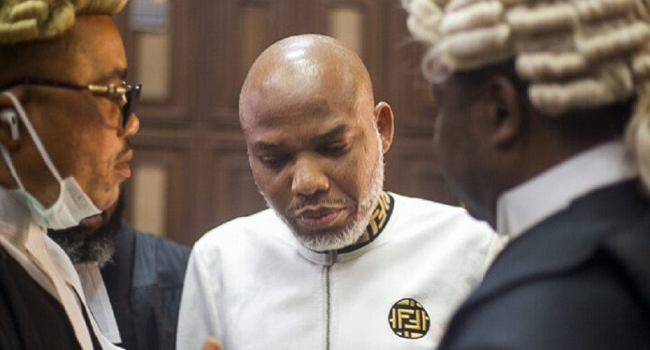
The long-running court battle involving the detained IPOB leader, Nnamdi Kanu, reaches a crucial point today as the Federal High Court in Abuja prepares to deliver its decision.
Justice James Omotosho is set to rule on several pending applications, including Kanu’s challenge to the charges brought against him and his request for release based on claims of unlawful detention and violations of his rights.
Kanu has remained in the custody of the DSS since June 2021 after what his legal team describes as his forced return from Kenya. He currently faces seven charges linked to incitement, operating an unlawful group, and actions viewed by the government as threats to national security — allegations he has consistently denied.
In a new application, Kanu argued that the law under which he was being prosecuted no longer exists, insisting that the charges should be thrown out as they do not establish any recognised offence. He also objected to the plea recorded on his behalf, claiming it was entered under misleading circumstances and against the spirit of a Supreme Court ruling. He asked the court to void all proceedings that followed and order his release.
Judge Faults Kanu Over Failure to Present His Defence
Justice Omotosho noted that after the prosecution closed its case on June 19, 2025, Kanu was given six days to open his defence but failed to do so. According to the judge, the court granted multiple adjournments to allow the defence team cross-examine witnesses, and therefore cannot be blamed for denying him a fair hearing.
He recalled that Kanu’s earlier bid to have the case dismissed through a no-case submission had been rejected, and he was instructed to proceed with his defence — a directive he initially accepted but later abandoned, maintaining that the entire process was invalid.
“The defendant has not shown readiness to defend this matter,” Omotosho said, adding that he had personally pleaded with Kanu to cooperate with the court and allow his lawyers to proceed.
Relying on past Supreme Court rulings, he held that a defendant who refuses to take the opportunity to defend himself cannot later accuse the court of unfairness.
With that, the judge concluded that Kanu had effectively waived his right to present a defence, clearing the way for the court to set a date for its final decision.
The case, which began in 2015 and has since been delayed by numerous motions, appeals, and reassignments, eventually returned to Omotosho’s court this year and moved at a faster pace. The prosecution called five witnesses and submitted several exhibits before resting its case.
All eyes are now on today’s judgment — a decision that will determine whether Nnamdi Kanu regains his freedom or continues to face trial on terrorism-related allegations.
