


Guinea-Bissau has plunged into another wave of political unrest as President Umaro Sissoco Embalo left the country for Senegal after being held during a sudden military takeover. Senegal’s government confirmed his arrival, while one of his strongest opponents accused him of engineering the upheaval to block the election outcome.
The military seized control a day before officials were expected to release provisional results from both the presidential and parliamentary elections. Soon after taking power, they named General Horta N’Tam, the army’s chief of staff, as the country’s new leader for a one-year transition. N’Tam, who has been seen as close to Embalo in recent years, was sworn in at the military headquarters.
Opposition candidate Fernando Dias da Costa, who claims he won Sunday’s vote, told AFP he believes the entire operation was staged to stop him from taking office. Dias alleged that Embalo, who also declared himself the winner, orchestrated the takeover. He said he narrowly escaped arrest when armed men stormed his campaign headquarters and has since gone into hiding. Another major figure who supported him, Domingos Simoes Pereira, was arrested.
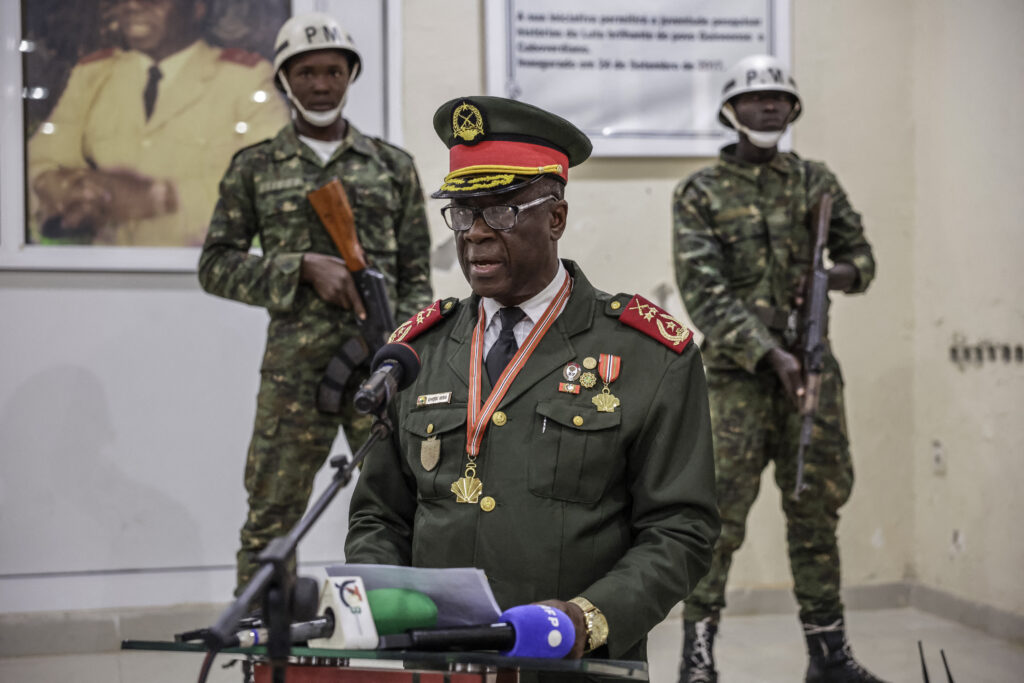
Guinea-Bissau, bordered by Guinea and Senegal, has long struggled with instability. Since gaining independence in 1974, the nation has experienced several coups and attempted takeovers. Sunday’s election is now at the center of the latest crisis.
The UN Secretary-General, Antonio Guterres, condemned the military action as an attack on democratic norms and called for the swift return of constitutional order. ECOWAS also suspended Guinea-Bissau from its decision-making activities until the situation is resolved, while the African Union and European Union issued strong statements urging an immediate restoration of democratic rule.

On Thursday, Bissau felt the weight of uncertainty. Shops were shut, markets were deserted, and soldiers were stationed across the city. The new military leadership temporarily banned media programming and protests, saying their actions were meant to “protect democracy.” They also cited an alleged plot involving arms smuggling and “drug lords,” though no independent verification has emerged.
Borders that were closed during the takeover have now been reopened, and the curfew lifted. The High Command has ordered businesses, markets, and schools to resume operations.

Still, many citizens and observers question the true motive behind the power shift. Some believe the upheaval may ultimately benefit Embalo, giving him room to reposition himself politically if negotiations work in his favor. Researchers say early, unofficial results circulating before the coup reportedly showed Dias in the lead.
For many locals, this latest crisis feels painfully familiar.
“Each time we start to hope for stability, something disrupts it again,” said Mamadou Woury Diallo, a soap seller in Bissau. “It just can’t continue like this.”
